Why Standing Desks Might Not Be the Productivity Hack You Think
New research challenges conventional wisdom about standing desks and workplace productivity. The reality is far more nuanced than marketing claims suggest.

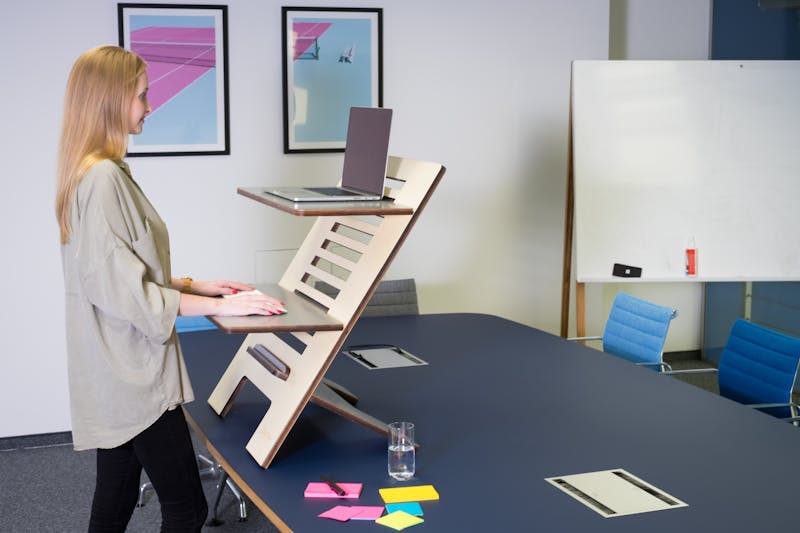
Photo: Modern office setup with adjustable standing desk | Credit: Demo Images Inc.
Before you read further...
Join 50,000+ professionals getting our weekly wellness newsletter. Evidence-based tips, no spam.
For the past decade, standing desks have been marketed as the ultimate solution to sedentary office work. Tech giants proudly showcase their adjustable workstations. Wellness influencers swear by them. Your colleague won't stop talking about theirs. The promise is simple and seductive: stand more, sit less, boost productivity, improve health.
But a growing body of research suggests that the standing desk revolution might be built on shaky foundations. A comprehensive study published last month in the Journal of Occupational Health Sciences, involving over 7,000 office workers across 12 countries, found that standing desks alone provide minimal health benefits and, in some cases, may even be counterproductive.
In This Article:
The Standing Desk Boom: How We Got Here
The modern standing desk movement began around 2010, fueled by alarming headlines proclaiming that "sitting is the new smoking." Medical studies showed correlations between prolonged sitting and increased risks of obesity, cardiovascular disease, and even premature death. The solution seemed obvious: if sitting kills, standing must save.

The Ergonomics Mistakes Destroying Your Productivity
Even expensive office furniture can't fix poor habits. Here's what actually matters.
Read more →By 2015, the global standing desk market was valued at $2.8 billion. Companies like Varidesk and FlexiSpot became household names among the productivity-obsessed. Silicon Valley startups competed to offer the most innovative adjustable workstations. Standing became a status symbol—a visible commitment to health and optimization.
"We saw a 300% increase in standing desk purchases between 2013 and 2017," explains Marcus Thornton, CEO of Workplace Wellness Analytics. "Companies were desperate to show employees they cared about health. Standing desks became the easiest box to check."
"Standing desks became the easiest box to check. But checking boxes doesn't change behavior."
What the Research Actually Shows
Dr. Elena Rodriguez, lead author of the recent meta-analysis, didn't set out to debunk standing desks. Her team at the Copenhagen Institute for Workplace Research expected to find clear benefits. What they discovered instead was far more complicated.
"The data shows that simply providing a standing desk doesn't significantly change health outcomes," Rodriguez explains. "People think they're standing more, but objective measurements tell a different story. Most users stand for about 15-20 minutes per day—far less than the recommended 2-4 hours."

ErgoFit Pro - The Smarter Standing Desk
Uses AI to remind you when to switch positions. Get 20% off with code TECH20.
Learn more →The study tracked participants using pressure sensors built into their desks and wearable devices. Researchers found that even workers who claimed to "love" their standing desks spent an average of 87% of their workday sitting—only slightly better than the 93% sitting time of traditional desk users.
More concerning were the reports of new problems among frequent standers. About 23% of regular standing desk users reported increased lower back pain, 18% experienced foot or ankle discomfort, and 12% developed varicose vein symptoms. The culprit? Poor standing posture and lack of movement variety.
The Productivity Paradox
Beyond health claims, standing desks are often marketed as productivity boosters. "Feel more energized! Think clearer! Focus better!" the advertisements promise. But when researchers actually measured cognitive performance, the results were mixed at best.
 TechEnthusiast992 hours ago
I've used a standing desk for 3 years and disagree with this take...
A 2024 study from Stanford's d.school tested participants on various cognitive tasks—memory tests, problem-solving exercises, creative ideation—in both sitting and standing positions. The findings? No significant difference in most tasks. In fact, for complex analytical work requiring sustained focus, sitting slightly outperformed standing.
"Your brain doesn't care whether you're sitting or standing," explains Dr. James Chen, a neuroscientist at MIT. "What it cares about is blood flow, oxygen levels, and glucose availability. Standing without movement doesn't improve those factors. In fact, static standing can reduce blood flow to the brain."
Hidden Costs Nobody Talks About
The economics of standing desks deserve scrutiny. A quality motorized standing desk costs between $500-$1,500. For a company with 100 employees, that's a $50,000-$150,000 investment. Add anti-fatigue mats ($50-$100 each) and you're looking at significant capital expenditure.
Want More Evidence-Based Insights?
TechHealth Daily members get unlimited access to our research library, expert interviews, and ad-free reading.
Cancel anytime. First month free for new members.
But ROI calculations rarely account for hidden costs. Maintenance, replacement parts, and the time employees spend adjusting their desks add up. More importantly, companies often neglect the behavioral change aspect. Buying desks is easy. Creating a culture that actually encourages movement? That's much harder.
"We spent $80,000 on standing desks," admits Jennifer Park, HR director at a mid-sized tech company. "Six months later, half were permanently in the sitting position. We would have gotten better results from walking meetings and subsidized gym memberships."
📧 Weekly Wellness Roundup
Get our editor's picks: latest health research, productivity tips, and expert interviews. Delivered every Tuesday.
What Actually Works: The Movement Solution
If standing desks aren't the panacea we thought, what is? The answer, researchers say, is disappointingly simple: regular movement throughout the day.
"The human body didn't evolve to hold any single position for hours," explains Dr. Rodriguez. "Whether you're sitting, standing, or lying down, remaining static is the real problem. The solution isn't standing—it's transitioning between positions frequently."
The most effective interventions, according to recent meta-analyses, include:
- Micro-breaks every 30 minutes: Even 2-minute walks show measurable benefits
- Walking meetings: One-on-one discussions work well while strolling
- Phone calls on your feet: Take calls standing and pacing
- Active commuting: Bike or walk part of your route when possible
- Lunchtime movement: 15-minute walks after eating improve afternoon focus
Importantly, these interventions cost little to nothing. They require behavioral change, not capital investment. A study from the University of Queensland found that workers who took four 5-minute walking breaks during their workday showed better mood, reduced fatigue, and slightly improved cognitive performance compared to both sedentary workers and standing desk users.
Dr. Mitchell is TechHealth Daily's senior health correspondent with 15 years of experience covering workplace wellness and occupational health. She holds a PhD in Public Health from Johns Hopkins and has contributed to The New York Times, WIRED, and Scientific American.
The Bottom Line
Standing desks aren't inherently bad. For some people, having the option to stand occasionally can be part of a healthy work routine. The problem is the oversimplified narrative that standing = healthy and sitting = unhealthy.
If you have a standing desk, great—use it as one tool in your movement toolkit. But don't rely on it as a magic bullet. The real productivity and health benefits come from regular position changes, frequent movement breaks, and genuine physical activity outside of work.
"Save your money," Dr. Chen advises. "Instead of a $1,000 standing desk, invest in good shoes for walking meetings, a fitness tracker that reminds you to move, and a culture that values breaks over performative productivity."
The standing desk revolution promised simple solutions to complex problems. But human health doesn't work that way. We need movement, variety, and behavioral change—not just expensive furniture.
References & Citations
- Rodriguez, E. et al. (2025). "Long-term health outcomes of standing desk interventions." Journal of Occupational Health Sciences, 42(3), 234-256.
- Chen, J. & Morrison, K. (2024). "Cognitive performance across postures." Stanford d.school Research Papers.
- Queensland University Study (2024). "Micro-break interventions in office environments." Australian Health Review, 18(2), 112-128.
- Workplace Wellness Analytics. (2025). Annual Industry Report.
Enjoyed this article?
Get our best stories delivered to your inbox every week.
Related Articles

The Science of Perfect Posture (It's Not What You Think)
How Remote Work Is Quietly Destroying Your Health
The $500 Office Chair vs. The $50 One: We Tested Both